Every great technological shift arrives first as a whisper. Not a shout. Not a trumpet. More like a tiny tickle at the back of your neck that makes you turn around and say, “What was that?” Most people wave it away. Some people frown. A handful sit bolt upright and begin rearranging their entire business.
History has taught this lesson before: when the centre of advantage shifts, the winners rebuild early. Electricity did that. It did not just light homes; it reshaped factories, cities, and working life itself. The telephone did not simply speed up messages; it collapsed distance and rewired how business was done. The internet did not just connect computers; it reorganised information, commerce, and power.
Trinidad and Tobago has seen quieter versions of the same pattern. Media houses that trusted printing presses and radio waves watched audiences drift to online-first platforms that understood reach had fundamentally changed. In every case, success belonged not to the strongest or the loudest, but to those willing to place the new source of advantage at the very centre of how they operated.
Artificial Intelligence is the next whisper, only this time it is growing louder far more quickly. And as before, the question is not whether it will change everything, but who will listen early enough and act decisively before the window closes.
For much of the post-industrial economy, scale acted as insulation and size felt like safety. Large organisations won by standardising operations, tightening controls, and institutionalising knowledge. This reduced unpredictability and made performance more consistent. The problem is that the same architecture that delivers predictability also creates delay.
As organisations grow, decision rights fragment, data spreads across systems and regions, and accountability is diluted by layers designed to manage risk. In a pre-AI environment, this trade-off was acceptable because markets moved slowly enough for planning cycles, precedent, and managerial experience to keep pace. In an AI enhanced environment, it becomes hazardous. Advantage now depends on fast learning loops, integrated signals, and the ability to act while conditions are still forming.
Large firms often cannot achieve this coherence quickly because information and authority are distributed by design. SMEs, by contrast, can reconfigure without negotiating through bureaucracy or legacy systems. Their speed is not a cultural preference; it is a structural necessity. And in a market where learning speed compounds, that necessity becomes a competitive weapon.
This is how incumbents lose ground. Not because they lack talent or resources, but because they are organised around the intelligence of a previous era.
Legacy media companies did not fall behind due to a lack of content, but because search and social platforms reorganised distribution and monetisation around information flow and attention at global scale. These challengers was not stronger, richer, or louder. They were organised differently.
So what should SMEs do if it wants to stop playing polite and start winning?
Do not copy the old shape of large organisations. Replace it.
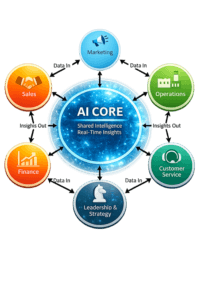
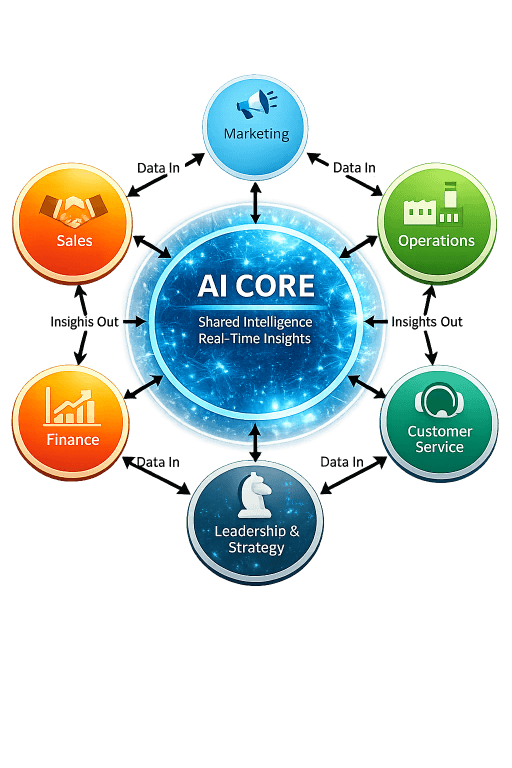
Imagine the organisation not as a pyramid of departments, but as a system of connected circles. Each department is its own circle, responsible for execution and outcomes. At the centre sits a larger one: a shared intelligence that feeds every function at once. That centre is AI.
In this model, departments do not operate independently and reconcile later. They respond together. When demand shifts, pricing, inventory, and resourcing pivot in sync. Finance does not interpret performance after the quarter closes; it identifies momentum while it is still actionable. Leadership does not manage by static reports or hindsight. It steers by live signals that expose change in the moment. Decisions remain human, but they are no longer made in isolation. They draw on integrated, real-time context rather than fragmented data.
Placing AI at the centre is not about installing software or adding tools to existing workflows. It is about redesigning how information moves and how decisions are made. Data that once sat locked inside separate silos must be unified and continuously interpreted. The priority moves from reporting past outcomes to detecting change as it happens. Clean data matters more than polished dashboards. Fast feedback matters more than long-range forecasts. Governance evolves as well, not to restrict access, but to ensure accuracy, accountability, and trust without reintroducing delay.
When this is done properly, the organisation changes character. Fewer surprises. Faster response. Better judgement applied while outcomes can still be influenced. Coherence replaces coordination, and learning becomes a shared organisational function rather than a departmental one.
This moment does not belong to the cautious or the comfortable. It belongs to those willing to move before permission is granted and before certainty dawns. SMEs are structurally equipped to do exactly that. They are not burdened by layers built to protect yesterday’s decisions, nor by systems designed to preserve past authority. They can redesign while larger organisations deliberate. When AI sits at the centre of the organisation, the advantage compounds. Learning accelerates faster than bureaucracy can respond. Decisions improve before committees can dilute them. Growth no longer requires proportional increases in staff, offices, or overhead. It requires the discipline to capture signals early and act without delay.
In Trinidad and Tobago and across the Caribbean, where margins are often narrow, logistics costs are high, and the margin for prolonged error is limited, speed and clarity are not luxuries. They are survival traits. AI-centred organisations scale judgement rather than mass. They expand reach without inheriting inefficiency. They test, discard, and refine while incumbents defend process.
This is how established players lose ground, not through collapse, but through hesitation. In periods of structural change, waiting is not prudent. It is decisive, and rarely in your favour. For SMEs in Trinidad and Tobago and across the Caribbean, this is not a theoretical opportunity. It is a practical one. AI lowers the cost of intelligence and raises the value of speed. A small team with a disciplined AI core can out-execute larger competitors by responding faster, pricing smarter, serving better, and wasting less. The only requirement is courage and design. Build the core. Connect the circles. Ship the first workflows. The market will not wait for you, but it will reward you if you move now.